
Low Demand, High Impact: The Case for Acceptance-Based Support in 2025
Revisiting the Work of Carl Rogers and Abraham Maslow

The education system is failing a growing group of students, autistic students, especially those struggling under the weight of modern demands. Traditional behaviour-based approaches, rigid expectations, and deficit-driven models aren’t working. And the harder schools push, the more these students retreat, burn out, or shut down completely.

We need to stop pushing and start listening.
When I talk about acceptance-based support, especially for autistic or neurodivergent learners, I always remind people that these ideas are not new. Two of the most influential psychologists of the 20th century, Carl Rogers and Abraham Maslow, were saying much the same over fifty years ago. Their work has shaped humanistic psychology, and if we had truly listened, perhaps our education system would look very different today.
Rogers’ inspirational Idea: The Student Comes First
Carl Rogers believed that real learning only happens in an environment of unconditional positive regard where the learner feels safe, accepted, and understood. He wasn’t talking about “soft” education. He was talking about a real connection. He argued that when students feel accepted, without pressure to be someone else, they’re more likely to engage, grow, and trust themselves.
Carl Rogers: Unconditional Positive Regard in Practice
Carl Rogers believed that every person possesses the ability to grow, develop, and thrive within themselves. His “person-centred” approach to therapy challenged the idea that professionals should direct or fix people. Instead, he offered a radical alternative: what if people changed best when they felt accepted exactly as they are?
Rogers coined the term “unconditional positive regard.” This meant offering acceptance, empathy, and genuine understanding without trying to control or manipulate the other person’s behaviour. In therapeutic settings, this approach enabled individuals to express themselves, explore their thoughts, and feel secure enough to develop at their own pace. It was not compliance-based; it was trust-based.
But Rogers did not stop at therapy. He applied the same ideas to education. He rejected the notion of teaching as information delivery and instead called for educators to become facilitators. In his view, learning is most powerful when it is self-directed, relevant, and emotionally safe. He believed that for students to learn, they must be able to choose how and when they engage, and they must feel valued as they are.
Today, we talk about trauma-informed practice, low-demand environments, and neuro-affirming support. But all of these ideas can be traced back to Rogers’ core message: people thrive when they feel accepted.

‘When the teacher has the ability to understand the student’s reactions from the inside, has a sensitive awareness of the way the process of education and learning seems to the student they feel deeply appreciative when they are simply understood not evaluated, not judged, simply understood from their own point of view, not the teacher’s.’
(Rogers 1961)
Sound familiar? For many autistic students, trust is the missing piece. Trust in adults. Trust in the environment. Trust that they’re not being set up to fail or pushed past their limits. Traditional systems continue to focus on outcomes, grades, behaviour targets, and compliance without first establishing safety.
Maslow Backed Him Up
Abraham Maslow is best known for his “Hierarchy of Needs,” of human motivation that begins with basic survival and ends with what he called “self-actualisation”, the ability to reach your full potential. Maslow argued that unless your basic needs for food, safety, love, and belonging are met, you will not have the capacity to grow, explore, or thrive.
In terms of education, this message is clear: students cannot learn if they are in distress, if they do not feel safe, or if they feel like they do not belong.
Maslow’s views on education were far ahead of his time. He criticised what he called the “fact-stuffing” approach to schooling, forcing students to memorise disconnected information with no relevance to their lives. He believed that education should guide young people in how to grow, discover meaning, and make wise choices.
His view wasn’t just about academic achievement. It was about helping each child become fully themselves. In this sense, Maslow understood that education should be human-first.
Maslow’s hierarchy of needs lays it out clearly: you can’t reach self-actualisation, learning, creativity, independence, without safety and belonging. For autistic students navigating sensory overload, social confusion, or chronic misunderstanding, those basic needs are often unmet.

‘Education is learning to grow, learning what to grow toward, learning what is good and bad, learning what is desirable and undesirable, learning what to choose and what not to choose.‘
Maslow (1971)
A Moment of Reckoning
Right now, autistic students are being labelled “demand avoidant,” “non-compliant,” or “school refusers.” But what if these are not signs of defiance? What if they are signs of distress? What if the system itself is the problem?
We’re in a moment where traditional support strategies have reached their limits. The reward charts, the behaviour points, the “just try harder” messaging, they’re not helping. If anything, they’re making things worse.
Why I Created the ACCEPT Approach
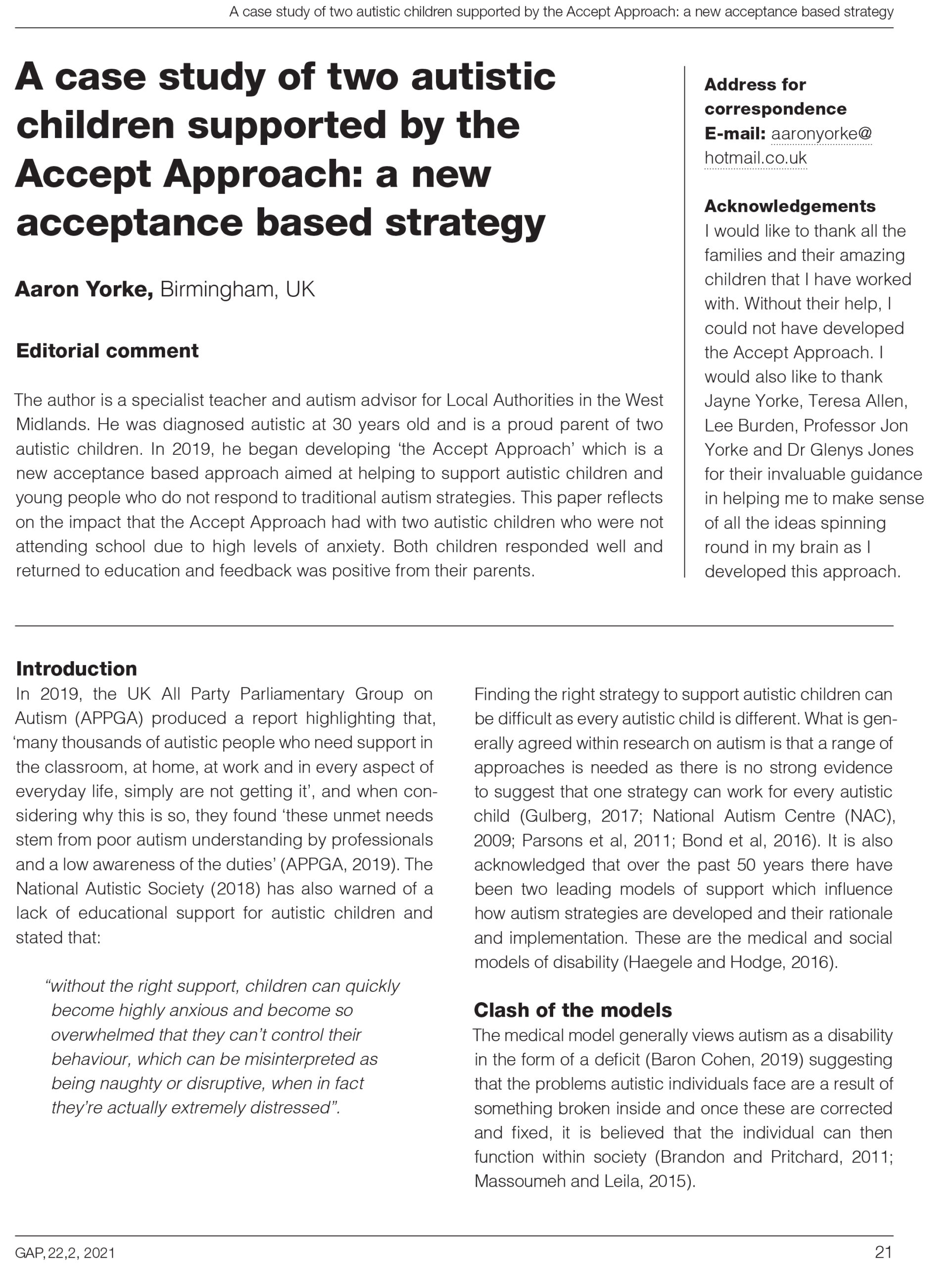
The ACCEPT Approach (Yorke, 2021) emerged from the crisis we are still in today, a need for something different rooted in acceptance.
Developed through lived experience, research, and real-world practice with autistic and demand-avoidant students, the ACCEPT Approach provides a practical, structured framework for applying acceptance-based values in education today.
As an autistic adult, educator, and parent, I have seen firsthand the damage that pressure-based and compliance-focused systems cause. I have also seen the life-changing difference when children are met with compassion instead of control, safety instead of stress.
I created the ACCEPT Approach to carry forward the inspired work of Carl Rogers and Abraham Maslow, two pioneers who understood that psychological safety is not optional but essential, and this is something I advocate for with all the students we support in our team.
The ACCEPT Approach
These ideas do not oppose education; they are a new direction for it. The ACCEPT Approach combines the practical application of acceptance into a clear, usable framework that families, schools, and service providers can begin using immediately. It helps professionals move away from “fixing” behaviours and towards understanding the child beneath them.
A New Foundation for Support
If nothing else has worked, why not try something different, rooted in acceptance rather than control? The Accept Approach is built on four foundational actions:
- Remove
Remove all demands, pressure, and environmental triggers that overwhelm or distress. - Remind
Remind the student that ‘It Is Not Their Fault’ they find things difficult. Remind them that there is no expectation to mask, perform, or please. Remind yourself that you are here to support, not to fix. - Reassure
Reassure consistently, not with empty phrases, but with presence, patience, and predictability. Let them know you will not pull away when things get hard. - Reaffirm
Reaffirm the child’s worth. Reaffirm their autonomy. Reaffirm that they are accepted as they are, not conditionally, not when they “behave,” but constantly.

The FOUR Foundations of The ACCEPT Approach.
Why Acceptance Should Matter Today
Despite decades of research and evidence, our education system still rewards compliance over connection. Many neurodivergent children are being excluded, isolated, or punished because their needs do not fit into the narrow boxes of what schools expect. Instead of seeing these children as broken or oppositional, what if we asked:
- Does this child feel safe here?
- Do they feel accepted as they are?
- Are we creating conditions for them to grow, or pushing them to fit in?
The answers matter.
Both Rogers and Maslow remind us that human growth is not driven by punishment or performance. It is driven by acceptance, safety, choice, and relationship. These values are not just therapeutic; they are educational. If we genuinely want to support children who are anxious, demand-avoidant, or traumatised by previous experiences, I believe we must go back to these core ideas.
This isn’t about doing less, it’s about doing what works. Acceptance is not passive. It is active, intentional, and grounded in empathy. For parents, teachers, and professionals who ask, “Nothing else is working; what do we do now?” the answer may be simple: try acceptance.
Try acceptance.
Not as a last resort, but as a first principle. When we meet autistic students with compassion, curiosity, and consistency, we create conditions that allow them to thrive, not just survive.
Acceptance is not about giving up or giving in. It is about showing up for the children who need us the most.